If the instrument ever looks out of date, tap refresh — it fetches the newest build. Your records are never touched; they live in the instrument’s own keeping, not in the page copy.
MAIN PAGE
OVERVIEW / INTRODUCTION
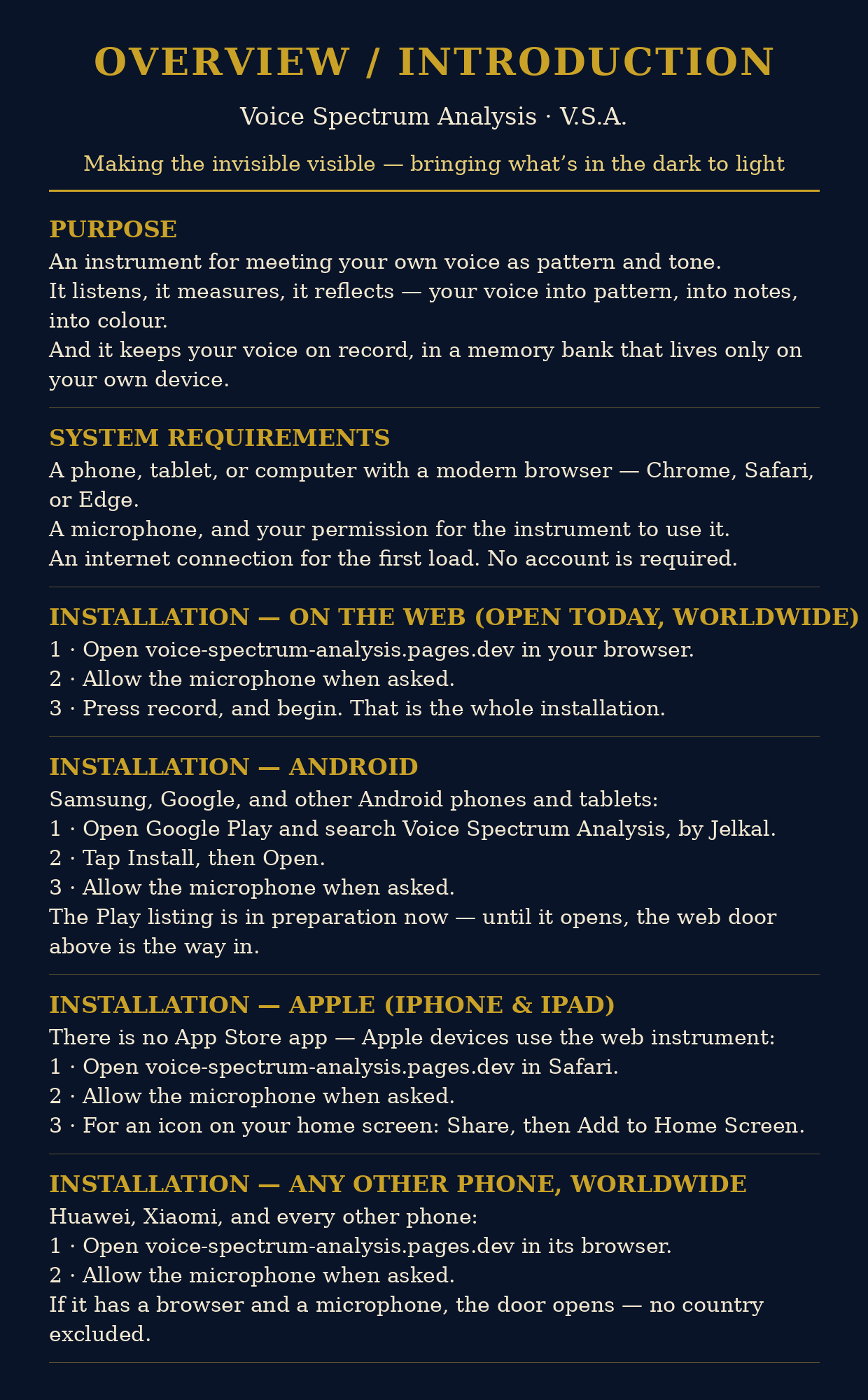
ABOUT THE APP
Voice Spectrum Analysis (VSA) — created by Jelkal (Angela Hodge). An exploratory instrument for meeting your own voice as pattern and tone: it listens, it measures, it reflects. Every measurement happens on your own device; your voice never leaves your telephone.
Version 2.1 — the current version of Voice Spectrum Analysis: the four tools and the shelf. The story of every version stands in the menu, under THE STORY & THE UPDATES.
Voice Spectrum Analysis (VSA) is an exploratory instrument for meeting your own voice as pattern and tone. It is not a medical device, and it does not diagnose, treat, cure, or prevent any medical condition — it listens, it measures, it reflects.
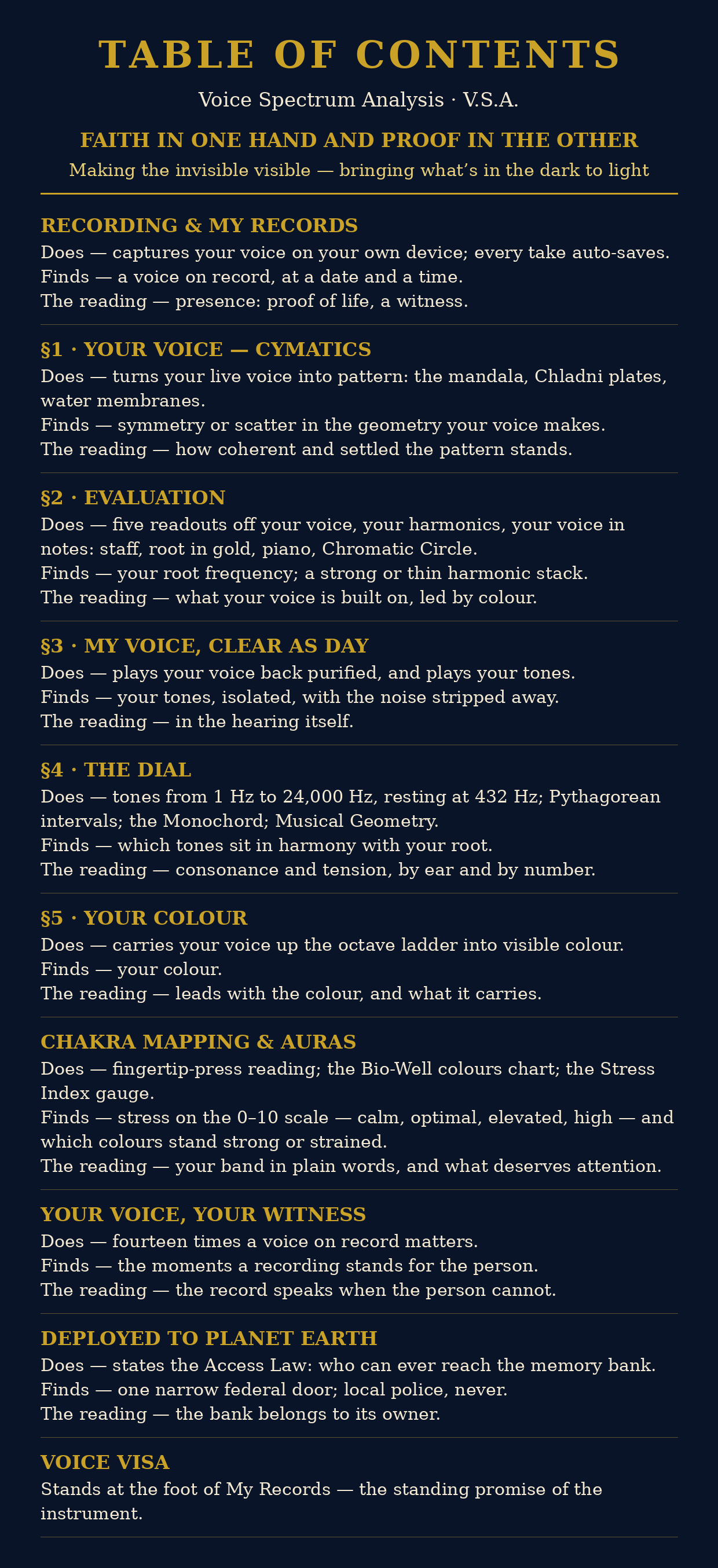
VSA TABLE OF CONTENTS
THE STORY & THE UPDATES
Built October 23, 2026, from the test trials of October 22–23: voice → pattern → voice → words, and voice → tones. All rights belong to Jelkal (Angela Hodge). Version 1.1 — the Colour Room (the octave ladder) added October 23, 2026. Kalvin Hodge. Version 1.2 — the dial gains fine steps (−10, −1, +1, +10) and an exact-number box, at Jelah's word the same morning. Version 1.3 — YOUR VOICE IN NOTES: the voice written in musical notation on a staff, the root in gold, at Jelah's word the same morning. Version 1.4 — the dial's note stands on its own staff in section 4, at Jelah's word the same morning (rendering corrected the same morning). Version 1.5 — the live colour bar and live cymatics in section 1: the colour your voice is making as you speak, and the pattern family of its strongest frequency drawn as you talk, at Jelah's word on October 24, 2026. Angela Hodge. Kalvin Hodge. Version 1.6 — the INFORMATION section: the instrument explains itself — spectrum, spectral, spectral signature — at Jelah's word on October 25, 2026. Version 1.7 — the four tools and the shelf: toggle through your voice and the colour, the pattern and the note travel with you; every note on the staff carries its letter; My Records opens a shelf on the device itself; and four standalone tools take their spots — Chladni Plates, Water Membranes, the Pythagorean Monochord under the dial, and Chakra Mapping — at Jelah's word on October 25, 2026. Version 2.1 — The version number counts the changes — ten changes to a step, from 0.1 at the first ten, climbing by tenths ever since, because the changes are grand. Two hundred and eighteen changes stand in the count — twenty-one steps of ten — and so the number stands at 2.1.
Angela Hodge — Owner and Creator of Voice Spectrum Analysis Kalvin Hodge — Executive Partner & Co-Owner
VSA is not a medical device, and it does not diagnose, treat, cure, or prevent any medical condition.
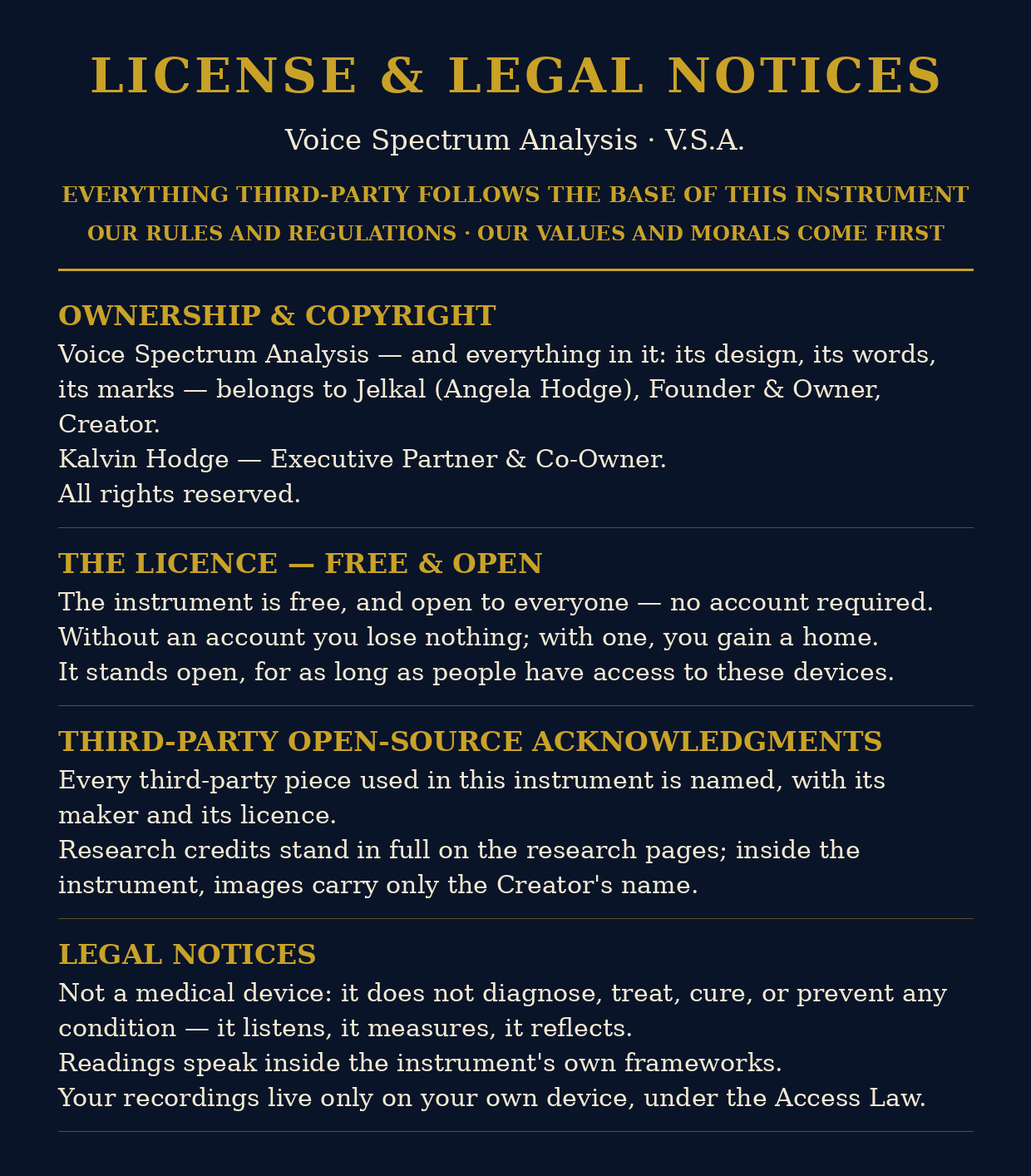
LICENSE & LEGAL NOTICES
PERSONAL IDENTIFICATION分析 PERSONAL INFORMATION
Your Identity — Locked
Your identity is under lock and key.
The phone did not say yes. Your identity stays locked.
Your Identity — Yours Only
Yours and yours only. This stays on your device — it is never sent anywhere. Your voice and your information are your own intellectual property, which you own.
Your Fingerprint — Only If You Choose
If you wish, keep an image of your fingerprint here — a photo or a scan that you choose. It is stored only on this device, never sent anywhere, and it is available only to you.
You can also drop an image here.
This device could not open the vault.
That was not an image. The fingerprint place takes an image.
Your Signature — Only If You Choose
Your signature is your hand’s own mark. If you want it kept with your identity, sign it on the screen below, or add a picture of it. It stays on your device, in the same sealed place as your fingerprint — it is never sent anywhere.
You can also drop an image here.
This device could not open the vault.
That was not an image. The signature place takes an image.
Under Lock and Key
Put your identity under lock and key. When this is on, seeing your identity asks your phone to confirm it is you — your fingerprint or your face. Your records open freely; your identity does not. The instrument receives only the phone's yes. Your print never leaves your phone.
The lock is off.
The lock was not set.
The phone did not say yes. The lock stays on.
This device or browser cannot ask for your fingerprint here, so the lock cannot be set.
MY RECORDS
VOICE SPECTRUM ANALYSIS RECORDS
Every recording this app makes is stored here — every single one, even the accidental ones — inside the app, on this device. Nothing is held hostage: open any take, save it to your device, or send it — today, or three weeks from today. A take you chose also stands on your My Records shelf. What stands in this room cannot be deleted from this room — the records stand.
Kept — Your Shelf
Your own shelf, on this device. What you save stands here — in the app on your phone and in the web page alike — and your voice never leaves this device to do it. One honest word: this shelf lives in this device’s storage, so clearing your browser’s data clears the shelf. Keep a download of anything precious.
VOICE VISA
MY SETTINGS
MY SETTINGS — § —
Your settings live on this device only. Nothing here is sent anywhere.
LANGUAGE
WHAT I AM USING IT FOR
YOUR VOICE, YOUR WITNESS
WHEN A VOICE ON RECORD MATTERS
Voice Spectrum Analysis — the other realm: scenarios where the instrument protects its client.
Gathered at Jelah’s direction, October 26, 2026. Every scenario rests on what the instrument already does — record your voice, timestamp it, and hold it on your own phone, under your own hand — and on the voice identification it is growing into. Jelkal holds nothing. No one holds your voice but you.
1. Kidnapping — proof of life
A family gets the call: “we have her.” Her voice is already on record. The voice on that call can be measured against her true spectrum — proof it is really her, and really alive, not an old clip and not a fake.
2. The AI clone scam
A scammer clones her voice and calls her mother, crying for money. Her real voice record exposes the copy: a clone can imitate her words, but not the living pattern underneath them.
3. A child lured by a “parent’s” voice
A stranger calls a child in a cloned parent’s voice — “come outside, it’s me.” The real parent’s voice is on file. It either matches, or it doesn’t. The child is protected by a voice that cannot be faked.
4. Domestic violence — documented in her own voice
She records what happened, in her own words, the night it happened. Timestamped. On her own phone. In a bank no one else can open, delete, or hold hostage. When she is ready, it speaks.
5. Assault — the account given once
A survivor gives her account once, in her own voice, in her own time — instead of repeating it to stranger after stranger. The record holds her exact words; the timestamp holds when she said them.
6. A stalker who won’t stop calling
Every threatening call is a voice. Kept takes build a dated pattern of the harassment — and the caller’s own voice, analyzed, is one more thread tying every call to one person.
7. Human trafficking — a take that gets out
One short recording, sent or smuggled out, can be verified against her profile: it IS her, she IS alive — and a voice under strain carries a state no script can fake.
8. Missing person — the found recording
A voicemail, a clip, a fragment surfaces somewhere. Measured against her record, it confirms her identity when there is no wallet, no documents, nothing else.
9. The person found unable to speak
Unconscious, phone in her pocket. Her records and her Personal Information identify her — who she is, and whose she is — while her voice waits safely on file for the day she can use it again.
10. Wrongfully accused
His own dated takes place his voice — awake, speaking, living his own life — on the nights in question. When memories fail and witnesses bend, his record still speaks for him.
11. Blackmail by deepfake
Someone fabricates “her” saying ruinous things. Her true record shows the fabrication does not carry her pattern. The fake is exposed as a fake.
12. A witness afraid to be named
Her statement is recorded early, in her own voice, timestamped and held by her alone — preserved whole, before pressure, fear, or time can bend it.
13. The elder and the “grandson in trouble” call
The family’s voices are on record. The frantic call can be checked against the real grandson’s spectrum before a single dollar moves.
14. When the worst has already happened
In a murder case — the one door the Access Law opens, federal only, from the top — a recording tied to the crime can be confirmed or cleared against the victim’s own record. Even then, her voice testifies.
Access note (her sealed law): police have no access at any time, for anything. Federal only — FBI, CIA, Homeland Security, RCMP — top of agency, gravest cases only, and any take travels only through the owner’s own hands and device.
DEPLOYED TO PLANET EARTH
THE ACCESS LAW OF WORLDWIDE LAW ENFORCEMENT
Who can ever reach the memory bank — Voice Spectrum Analysis · V.S.A.
DEPLOYED TO PLANET EARTH — NO COUNTRY EXCLUDED
THE FEDERAL RUNG — COUNTRY BY COUNTRY
UNITED STATES — FBI · CIA · Homeland Security
CANADA — RCMP · CSIS
UNITED KINGDOM — MI5 · National Crime Agency
AUSTRALIA — Australian Federal Police (AFP) · ASIO
GERMANY — BKA, Federal Criminal Police
FRANCE — DGSI, Internal Security
CHINA — Ministry of State Security · Ministry of Public Security
RUSSIA — FSB, Federal Security Service
INDIA — CBI · Intelligence Bureau
JAPAN — National Police Agency
WORLDWIDE — Interpol, the network linking the police of 196 countries (coordination only; no powers of its own)
The same terms bind every organization on this list and every organization under them: the top of the agency only · three avenues · murder and kidnapping only · through the owner’s own hands only · never against the client.
Right down to the owner — the client whose voice it is, using the service provided. The record belongs to the owner, for their rights, their protection, their benefit, and their defense.
MORSE CODE
MORSE CODE — § —
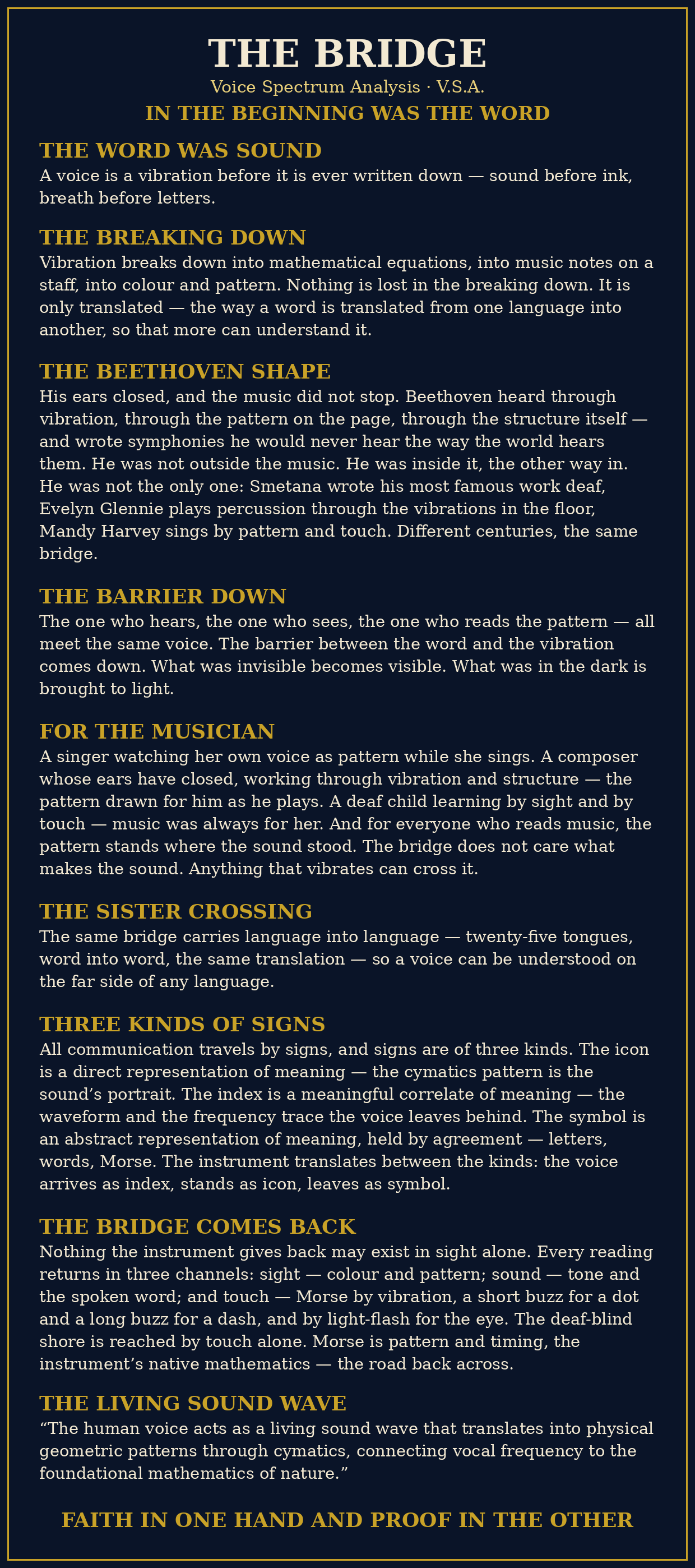
Speak it in, or type it in — it comes back in Morse: by tone, by touch, by light.
Write your words, or speak them, and the instrument sends them back in Morse code — the oldest electric language of signal. Pick any letter in the grid below to hear, feel and see that letter alone.
THE LIGHT
SPEED
One dot = 90 ms
CHANNELS — ALL THREE, TOGETHER
This device does not offer vibration; tone and light still stand.
TAP IT IN
Tap the key for a dot, hold it for a dash. Pause, and the letter is read; pause longer, and a new word begins.
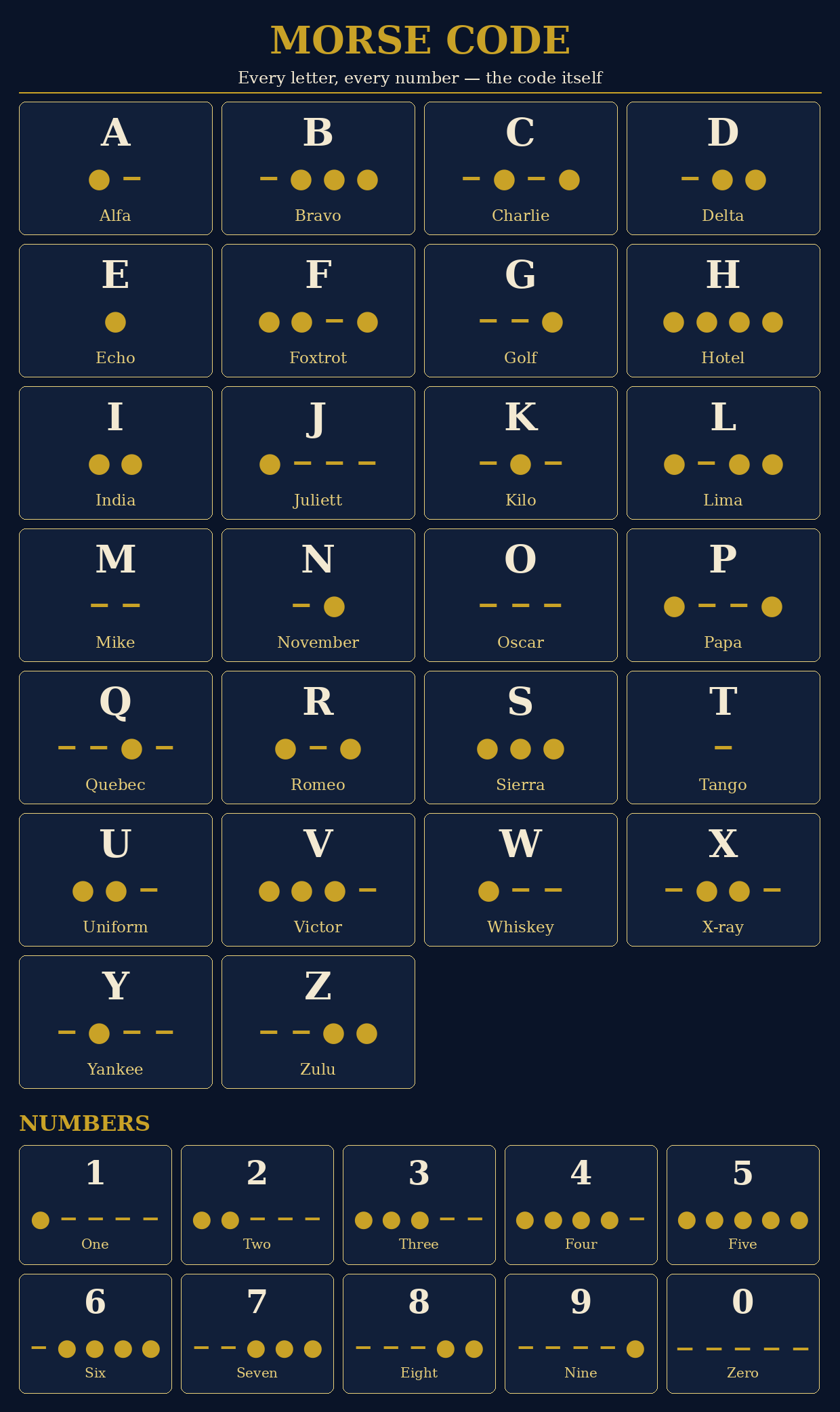
EVERY LETTER, EVERY NUMBER
Tap any box to send that one letter through all three channels.
READ MORSE FROM A PICTURE — § —
Clean, straight Morse reads best. A tilted or dim photo may read rough — the words it finds stand below, so a wrong letter can be seen.
Distance signals
Over the centuries, humans have come up with various methods that could be used over some distance. Native Americans reportedly used smoke signals, those from other cultures made similar use of signal fires, but such efforts were very limited in terms of extent and complexity of message. Others used bells, whistles, horns and a variety of other "noise makers", with similar limitations. At some point, written messages carried by runners, horsemen and pigeons began to be used and improved the quality of communication.
A ham operator's account of Morse
Before around ww-1 there were 2 kinds of morse code, us and international with some marked differences. International morse code is used nowadays exclusively, although I am curious te know whether any hams experiment with us morse code.
The first morse code operators, working for railway companies, used only numbers that were looked up in a code book. Letters in morse code were added later.
Some of these numbercodes still survive among ham cw operators (like me). The well known "73" for "bye" (at the close of a qso (contact)) and "88" for "love and kisses" are 2 examples of this. chracters if a cw ham contact are usually two dots, like two "e"s, but too widely spaced to be recorgnised as letters.
Morse code is very much alive, just tune into the lower ends of the shortwave ham bands . A contact in cw is very often possible when, due to weak signals, interference or noise, an ssb (speech) contact would be impossible.
THE SIGNAL FAMILY
THE SIGNAL FAMILY — § —
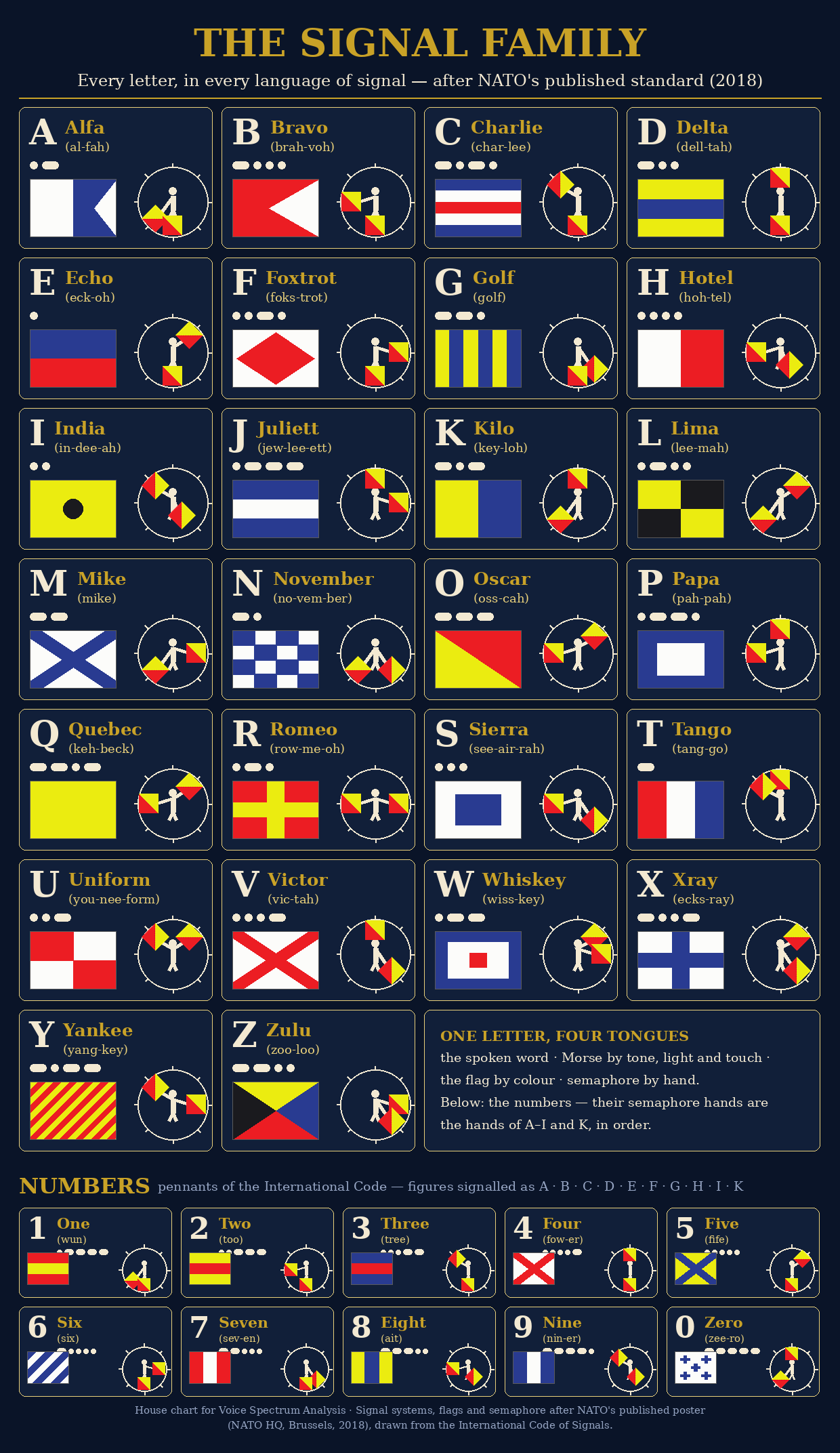
Every letter, in every language of signal — the poster, redrawn in the instrument’s colours, verified cell by cell against NATO’s standard (2018).
SIGN LANGUAGE
SIGN LANGUAGE — § —
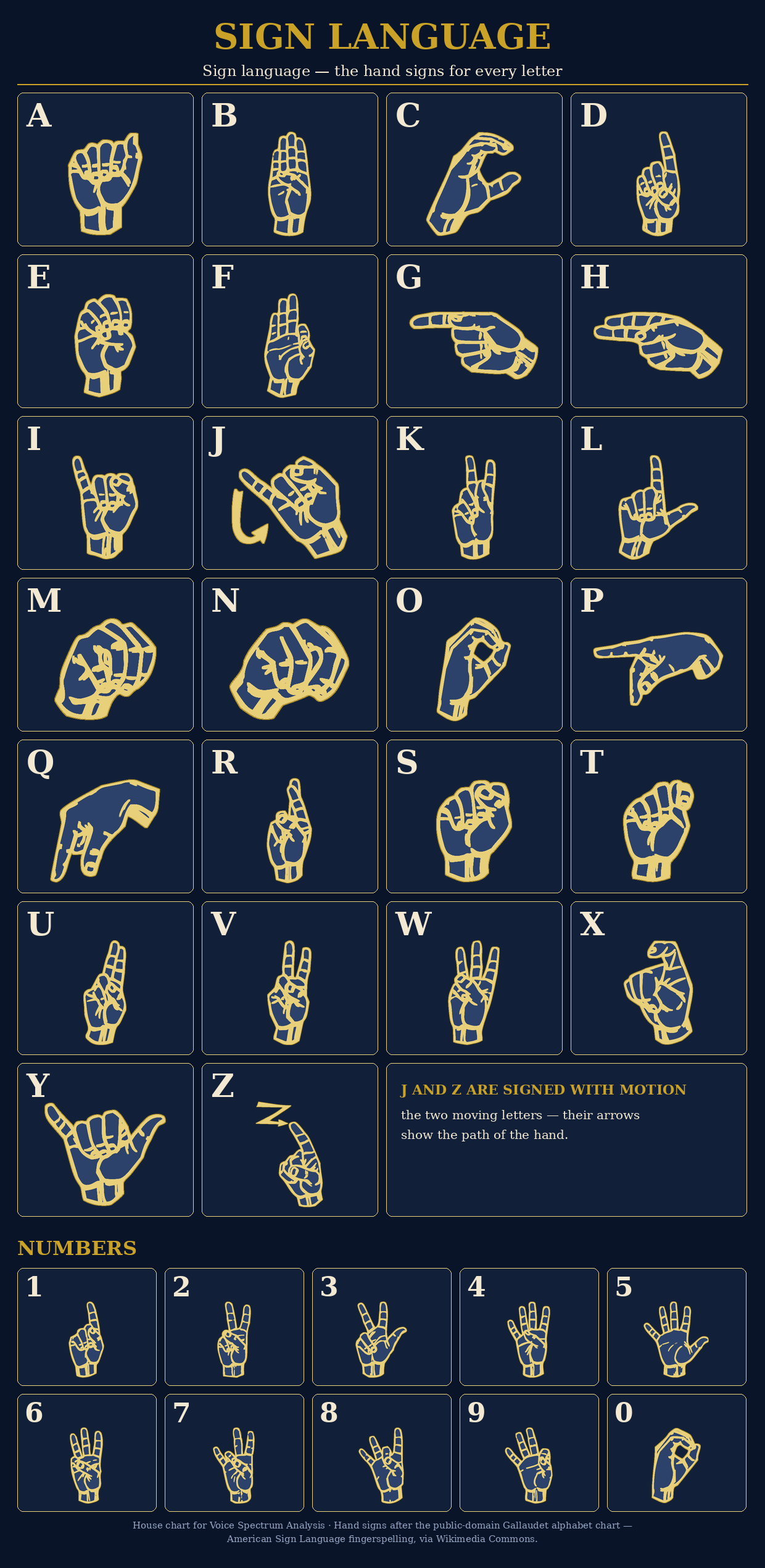
Sign language — the hand signs for every letter.
WRITE IT IN SIGN LANGUAGE
SPEED
One sign = 800 ms
PLAY TOGETHER
These signs spell words letter by letter — the fingerspelling of the chart below. Sign language is a full language of its own; this is its alphabet, put to work.
BRAILLE
BRAILLE — § —
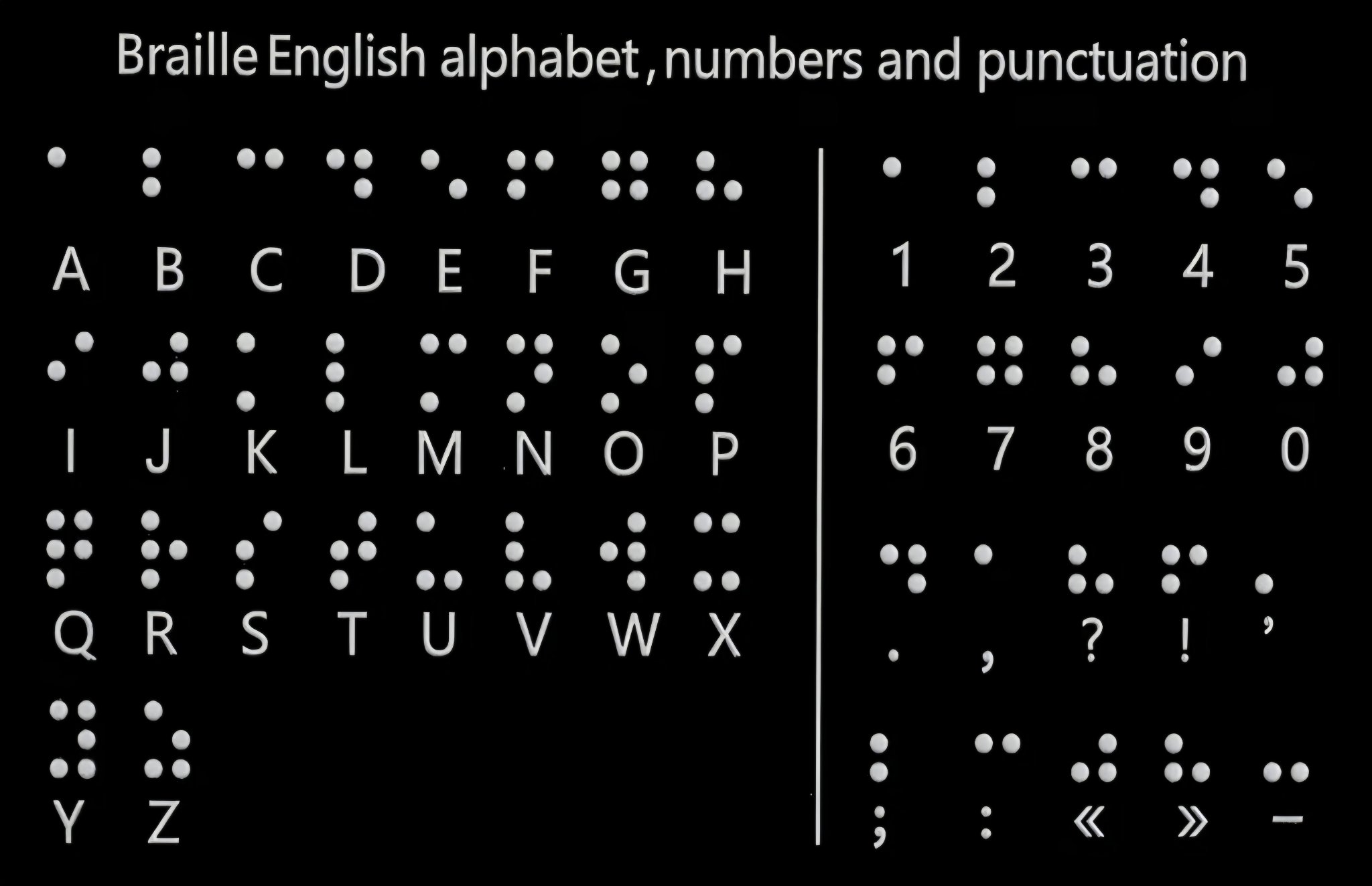
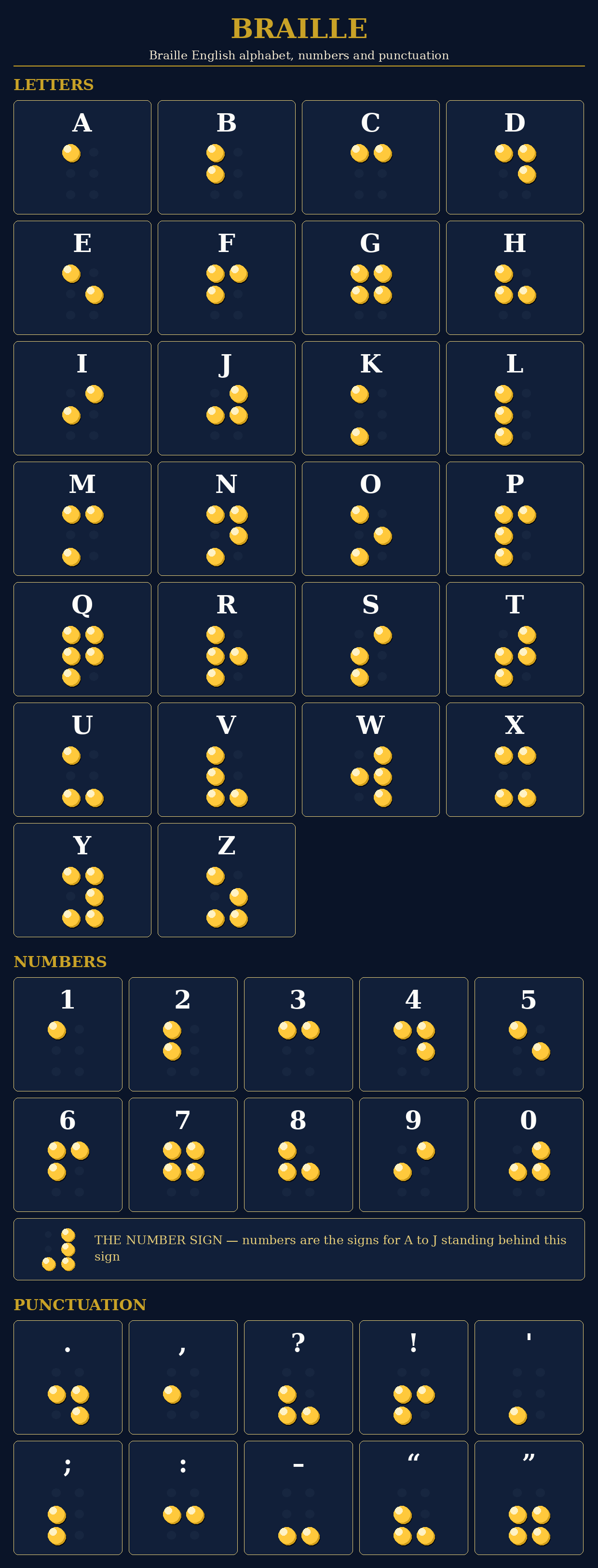
Translate physical braille into plain text or teach braille literacy using mobile devices
READ BRAILLE — § —
Use side lighting: position a light source from the side to cast shadows on the raised dots so the software can detect them clearly.
WRITE IT IN BRAILLE
PLAY TOGETHER
Reading Braille from a picture happens on this device. Translating into another language uses the same translation road as Language Spectral Analysis.
Clean, straight, side-lit Braille reads best. A tilted or dim photo may read rough — the text it finds stands below, so a wrong letter can be seen.
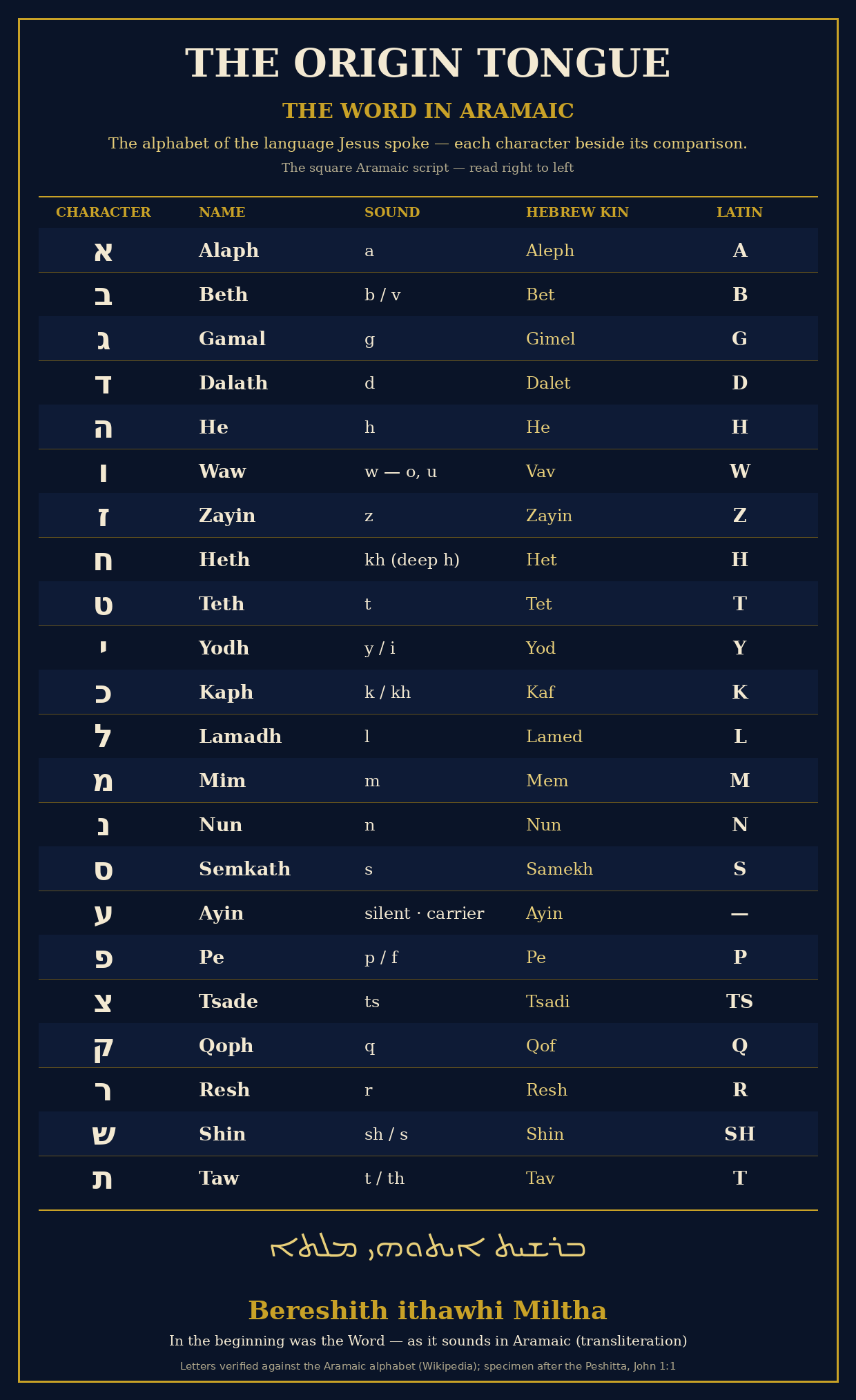
THE ORIGIN TONGUE
THE ORIGIN TONGUE — § —
WRITE IT IN ARAMAIC
Type your words — they come back written in Aramaic, and the button plays them in Aramaic. Type Aramaic — it comes back written and spoken in your language.
This converter writes letter for letter from the verified alphabet above — it spells words in Aramaic letters; it does not translate their meaning. The ancient script writes the consonants: A rides on Alaph, I on Yodh, O and U on Waw, and E is not written, as the old letters did not write it. When it plays, it speaks the letters’ sounds spelled out in your language — a true Aramaic voice does not exist on any phone yet. It grows here, reading by reading.
PRACTICE — LEARN IT HERE
The first line, word by word. Tap a word: see it in Aramaic, hear it played, and spell it letter by letter.
EVERY LETTER — TAP IT, HEAR IT
Tap any letter: see it large, and hear its name and its sound.
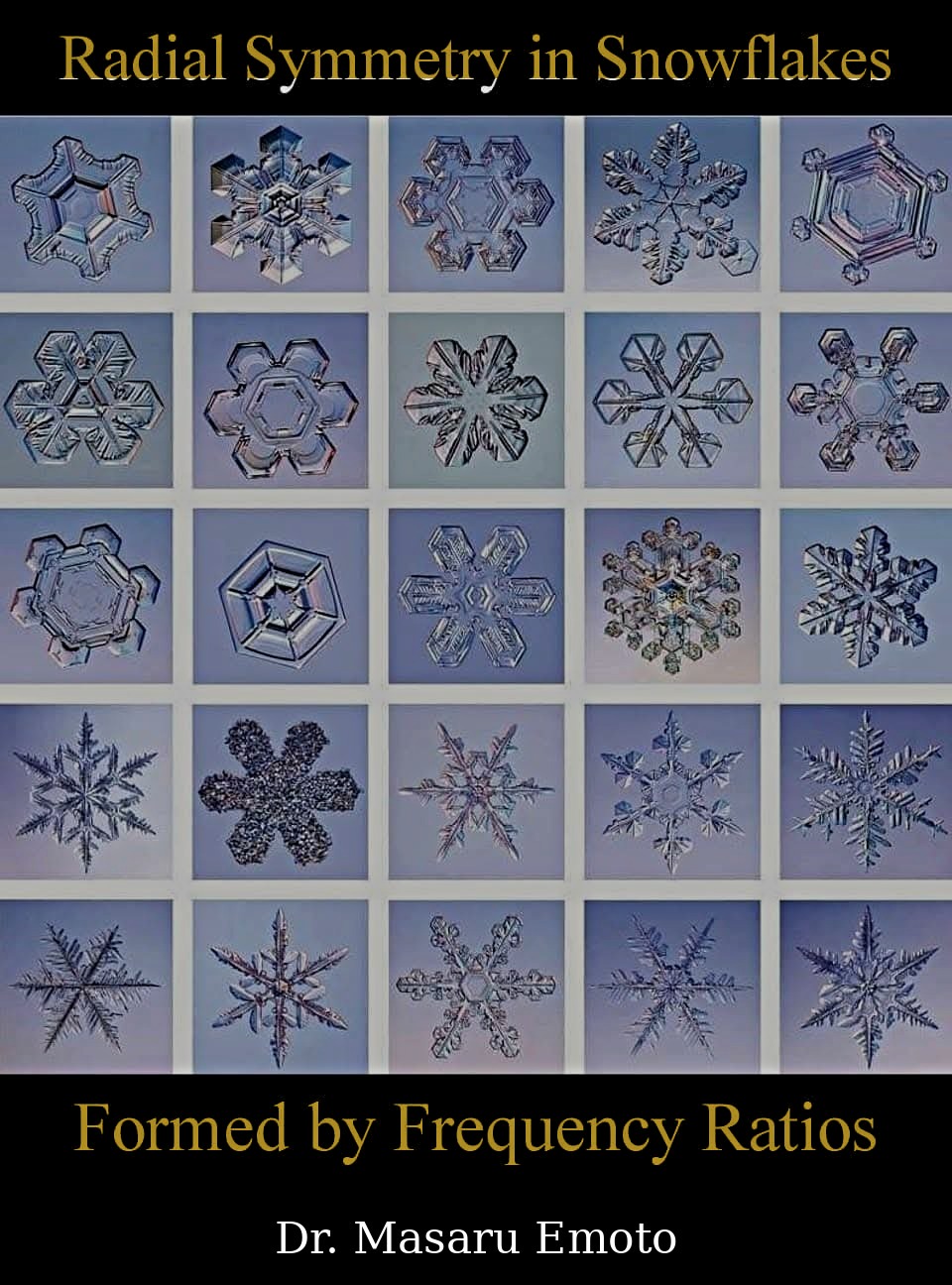
DR. MASARU EMOTO
DR. MASARU EMOTO — § —
VOICE SPECTRUM ANALYSIS
V.S.A.
Put your own voice in. Watch it become its pattern. Hear it returned to you — your voice, clear as day; your tones; and a dial to tune with. A Jelkal work in progress. Your voice never leaves your telephone: every measurement happens right here, on this device.
बेबी स्टेप्स हो गए
Download this to your phone V.S.A.
Optional — she works fully right here in your browser. The icon just gives her a home on your phone.
To add her: open your browser menu ( ⋯ ) and choose Install app or Add to Home screen. On iPhone: tap Share, then Add to Home Screen.
ܒܪܫܝܬ ܐܝܬܘܗܝ ܡܠܬܐ
Bereshith ithawhi Miltha
In the beginning was the Word — in Aramaic
ⓘ INFORMATION — WHAT YOU'RE LOOKING AT
Voice Spectrum Analysis (VSA) is an exploratory instrument for meeting your own voice as pattern and tone. It is not a medical device, and it does not diagnose, treat, cure, or prevent any medical condition — it listens, it measures, it reflects. Every measurement happens right here, on your own device; your voice never leaves your telephone.
THE WORDS, PLAINLY
Spectrum — a noun. The range itself: a continuum, a band of frequencies, colours, or signals, laid out from low to high. It names the thing being looked at — here, the whole spread of frequencies your voice contains.
Spectral — an adjective. Relating to, or involving, a spectrum — as in spectral analysis, spectral lines, or a spectral fingerprint. It names the way of looking.
Spectral analysis — examining a signal across its frequencies: which frequencies are present, and how strong each one is. In natural science it is used to detect the physical structure and composition of things. Here, it is turned on a voice.
Spectral signature — “the specific reflective properties of a material.” A voice has one: the particular pattern of frequencies that is yours alone. That spectral signature is what this instrument renders — as a wave, as notes on a staff, and as colour.
Image spectrometry — in plain words: a spectrum you can look at. It joins spectral technology to imaging technology, so that every point of a picture carries its own spectrum. The live colour bar and the cymatics drawing in section 1 are this instrument's own way of doing that — your voice, made visible.
Harmonics & Overtones — every sung note contains a fundamental pitch plus a ladder of higher resonant frequencies. These extra harmonics are what give a voice its unique timbre, and cause cymatic shapes to fluidly morph even during a single tone. The ladder is standing in your Evaluation spectrum, if you look: the tall peak is the fundamental, the smaller peaks climbing after it are the harmonics.
WHAT EACH PART SHOWS
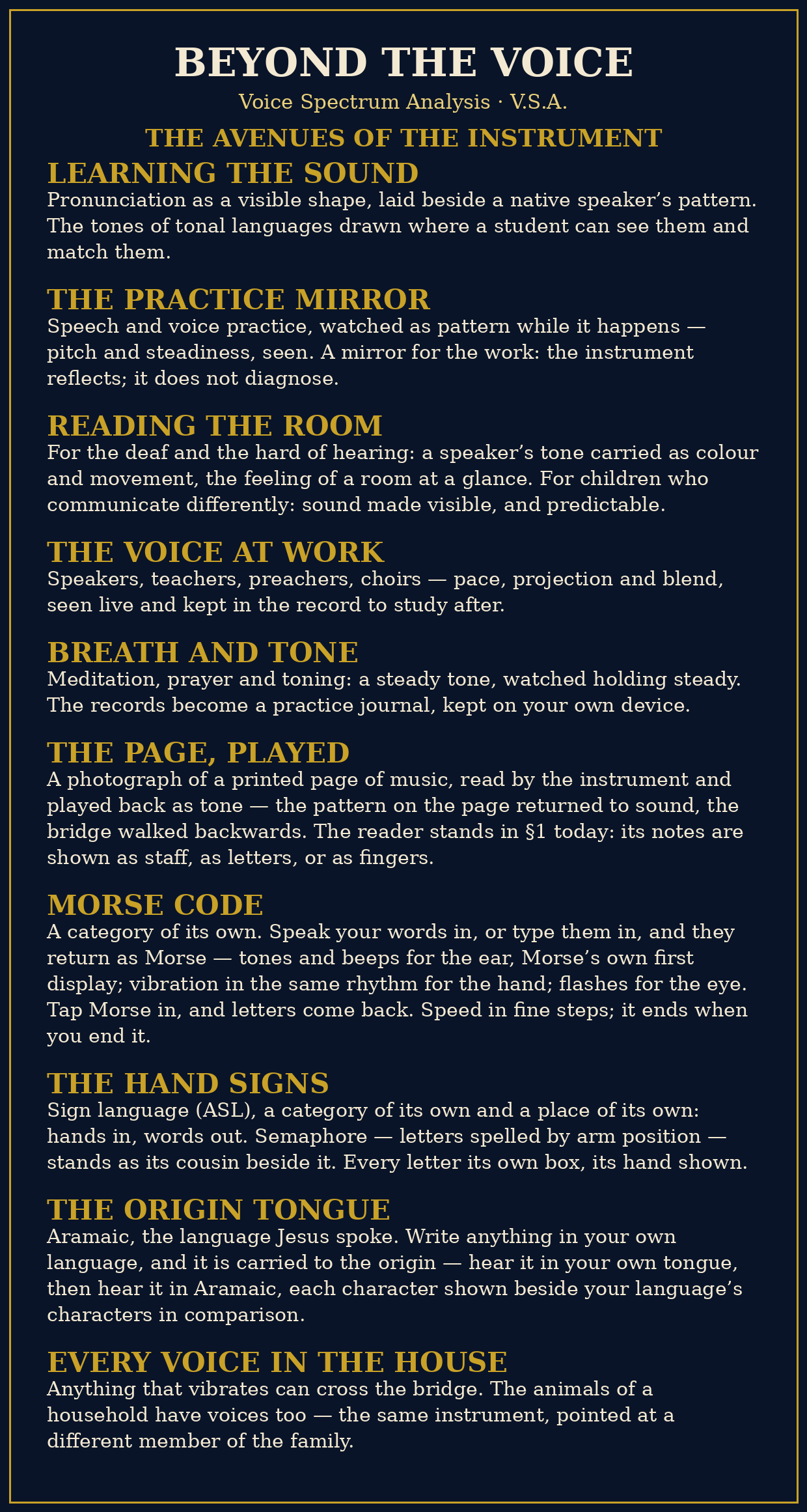
Your Voice, In — record or load your voice, and see its wave, its colour as you speak, and the cymatic pattern family of its strongest frequency.
The Evaluation — your voice measured: pitch centre, nearest note, pitch range, strongest frequency, and length — and your voice written in notes on a staff, your root in gold.
Your Voice, Returned — hear your own voice played back clear as day, and hear its tones.
The Frequency Generator — the Dial — a frequency dial you can tune by slider, by fine steps, or by an exact number, and play.
Your Colour — The Octave Ladder — your root frequency doubled up, octave by octave, into the visible band: the colour of your voice.
YOUR VOICE — § —
Record my voiceREC0.0s
No voice yet. Record a few seconds — a verse, your name, anything — or load a voice note.
Play my voice
Stop my voice
Volume
THE ORIGINAL LINE — AS IT CAME IN, WHILE YOU RECORDED
THE PLAYBACK — YOUR VOICE, MEASURED
0.0stap or drag the wave to move through your voice
0:00 / 0:00
432 Hz
Exact:Hz — type it, or step it
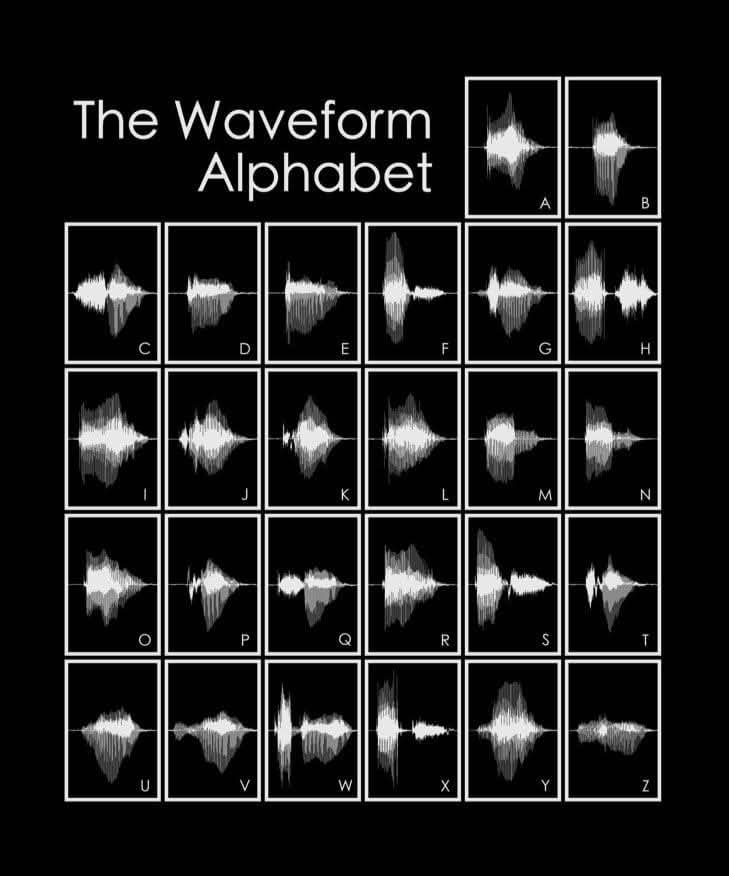
THE WAVEFORM ALPHABET Every letter, drawn as the waveform of its spoken name — your wave above, the alphabet's waves below. From Jelah's research shelf.
your colour, livethe colour your voice is making, as you speak
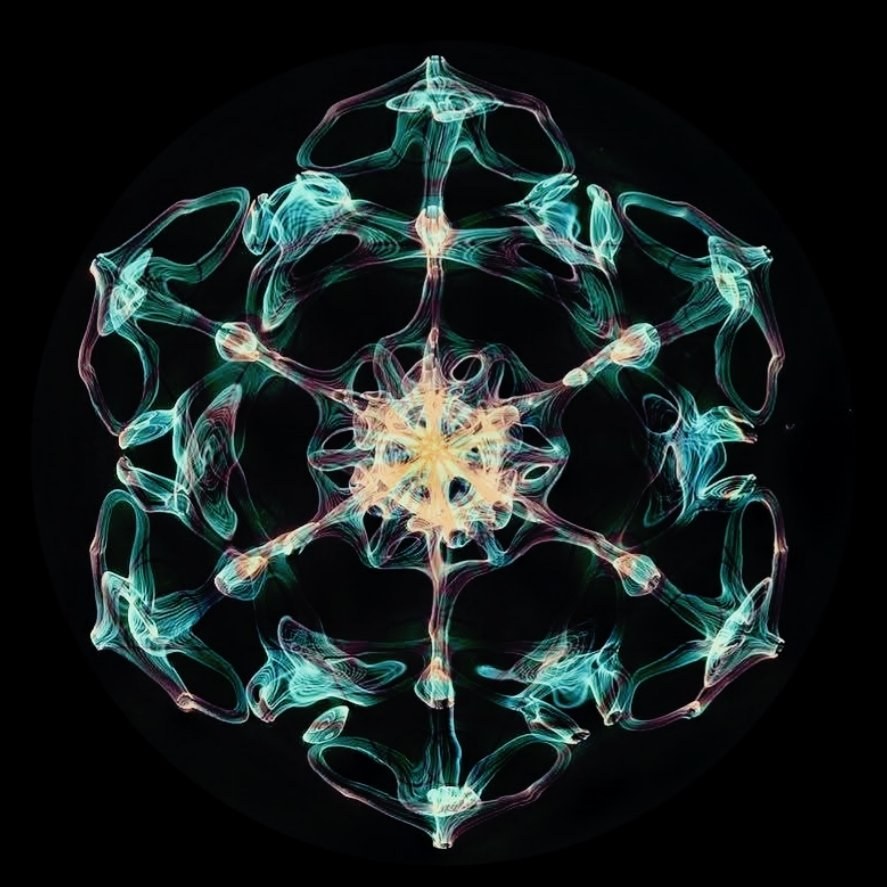
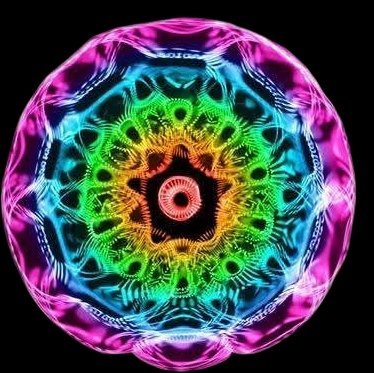
cymaticsthe pattern family of your strongest frequency — drawn live, a drawing, not a photograph of a plate
move through your recording
Drag the wave above, slide here, or tap − / + to step a tenth of a second at a time — your colour and the cymatic pattern move with the exact moment you are standing on.
CHLADNI PLATES — THE PLATE
Chladni Plates — flat metal plates covered with sand or salt that form intricate geometric shapes when a violin bow or frequency generator excites them.
432 Hz
Drag the slider and watch the sand settle into a new figure at every frequency — the shape is the sound, held still.
Non-Newtonian Fluids — using materials like cornstarch mixed with water over a speaker creates dynamic, three-dimensional moving sculptures that dance to music notes.
The board above draws the pattern family of your strongest frequency. These are its three physical homes: the shape held in sand, the shape alive in water, and the shape that dances.
WATER MEMBRANES — THE WATER
Water Membranes (Tonoscopes/CymaScopes) — using a water surface to capture real-time acoustic ripples, revealing highly fluid and dynamic “CymaGlyphs” from vocal or instrumental harmonics.
432 Hz
The same pattern, alive in water — ripples carrying the figure, never holding still.
THE FIRST VOICE — A WORKED EXAMPLE
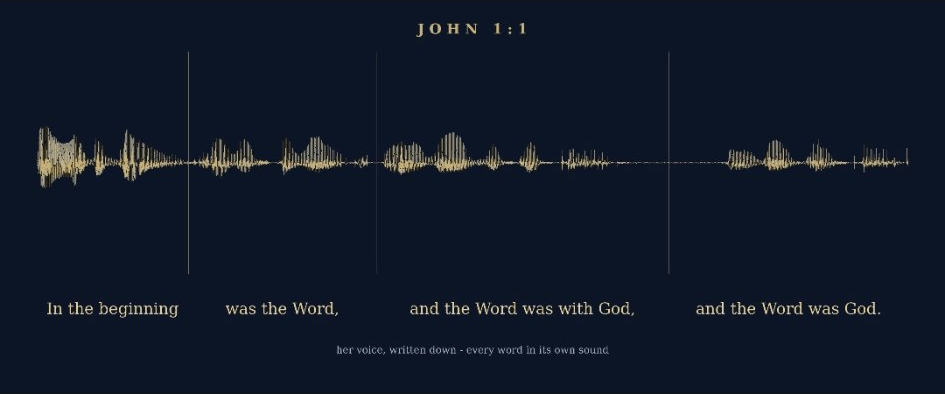
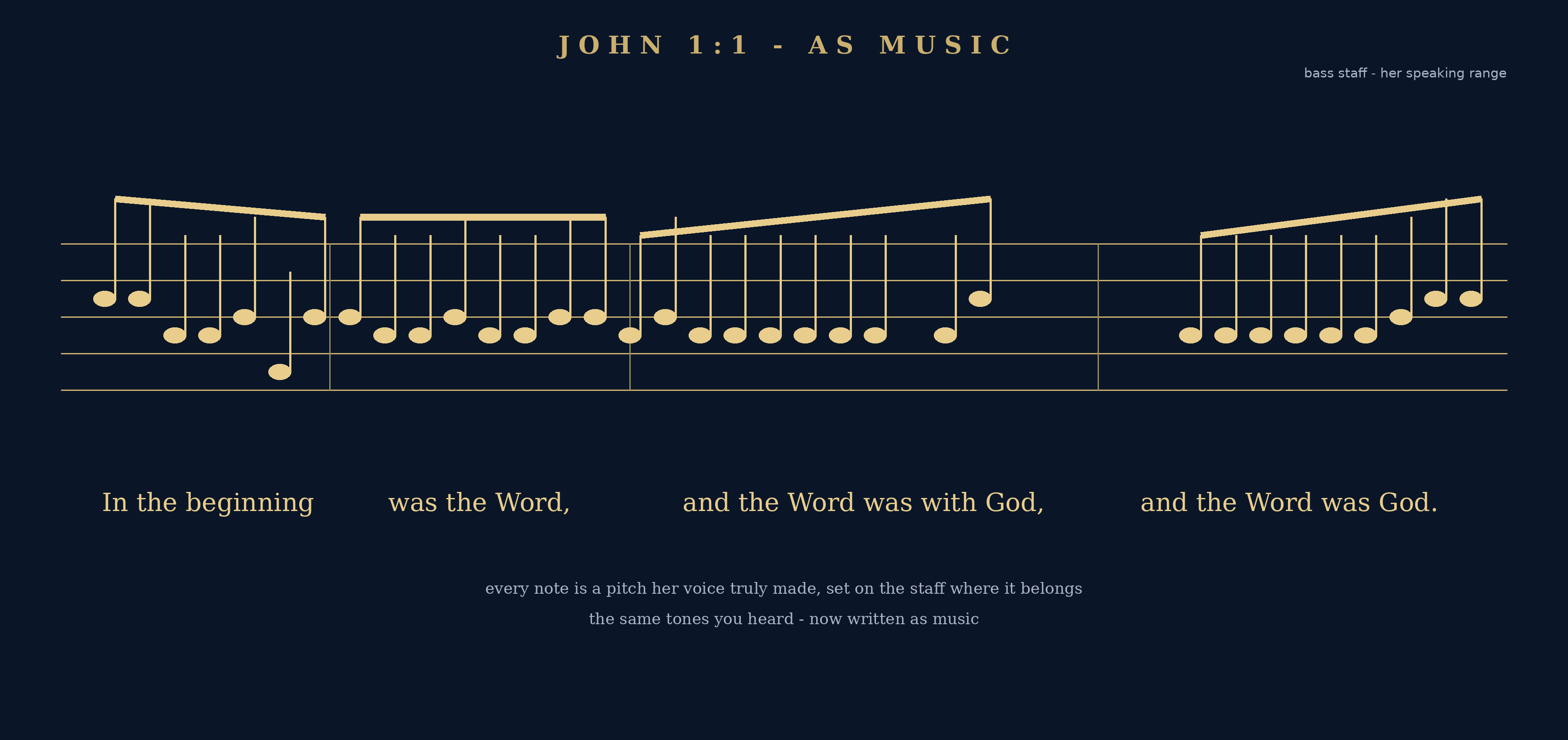
New here? Start with the voice this house was built on. This is Jelah reading John 1:1 — the canonical take from the test trials of October 22–23, 2026. Press play and hear her say it — then record your own voice above, and watch the instrument do the same for you.
THE EVALUATION — § —
low frequenciesyour voice, frequency by frequency, across timehigh
—pitch centre of your voice
—nearest note
—pitch range
—strongest frequency
—length of your voice
YOUR VOICE IN NOTES
Not only the wave — the music. The notes your voice sang, written on the staff. Your root note stands in gold.
Record your voice above, and your notes will stand here.
0.0sslide to travel through your notes — the note you stand on lights up, and it lights up as your voice plays
your notes, on the pianothe key lights as your voice reaches it — slide above, and the piano and the staff travel together
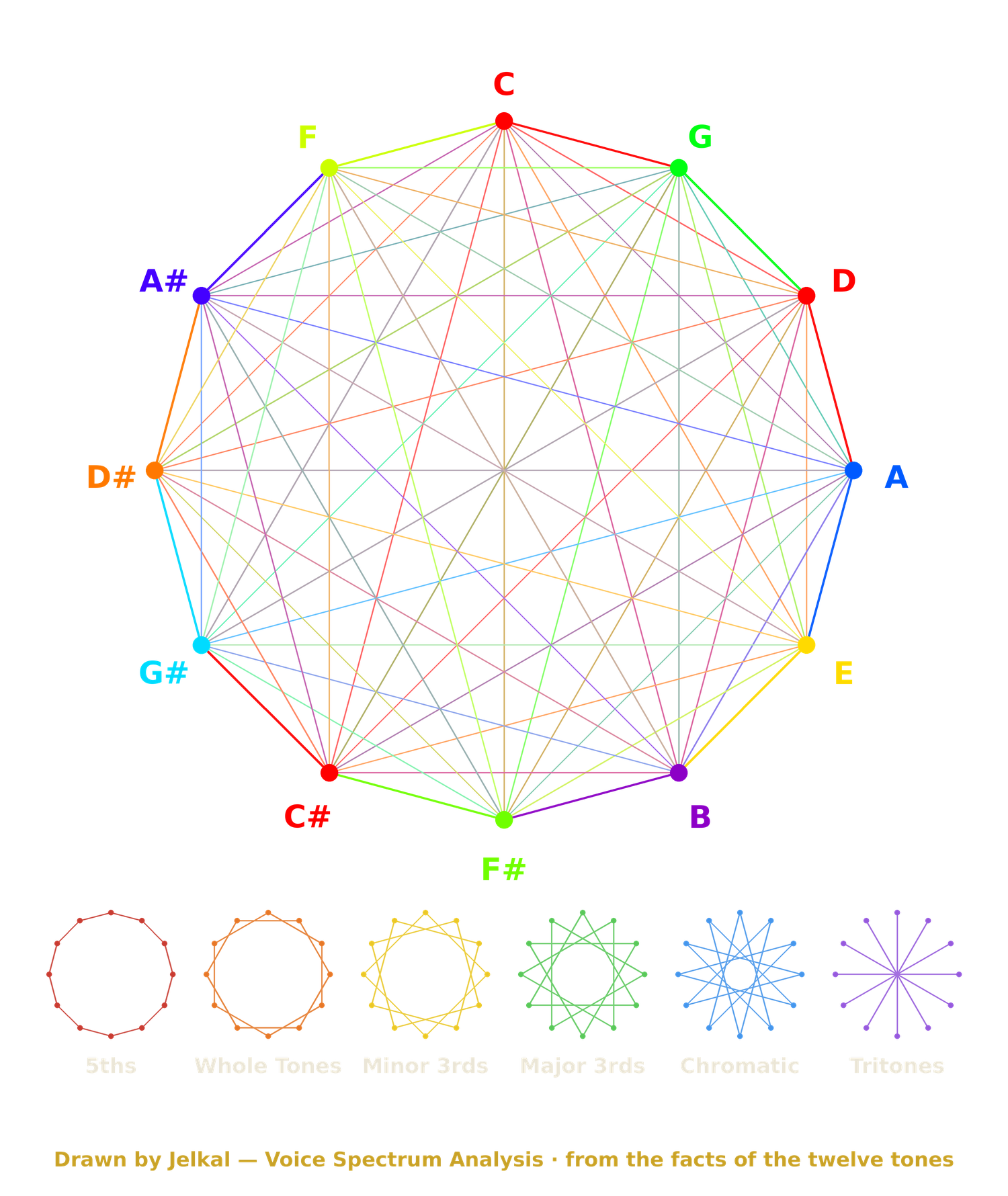
THE CHROMATIC CIRCLE The twelve tones, and every interval between them, drawn as one web — the map your notes live on. Touch a note and its web lights and sounds; while your recording plays, or you slide through it, the circle follows — the note you stand on, and every line it leads. Drawn by Jelkal from the facts of the twelve tones.And the same circle, standing still — the portrait plate, with the six families beneath it: fifths, whole tones, minor thirds, major thirds, chromatic, tritones. Drawn by Jelkal.
THE PAGE, PLAYED
A printed page, read and played. Upload a photo of printed sheet music and its notes land here — see them on the staff, as letters, or with their finger placements, fix any note that read wrong, and hear the page played. Or begin from the blank staff and put your own notes in.
No page read yet. Upload a printed page, or tap the staff to begin your own.
The Fingers view is suggested fingering, from a five-finger position — 1 is the thumb, 5 the pinky; ↑ and ↓ mean the hand shifts. Your own hand has the final word.
Octave 4
The library holds well-known hymns, classical themes and traditional songs, kept on this device. A page is named only when its notes match closely, in any key.
Every note plays the same length for now — rhythm reading is a later build. The first version reads clean printed treble pages, one melody line, natural notes; sharps and flats on a page are not read yet — the ♯ above and the ▲▼ on each note are there for them.
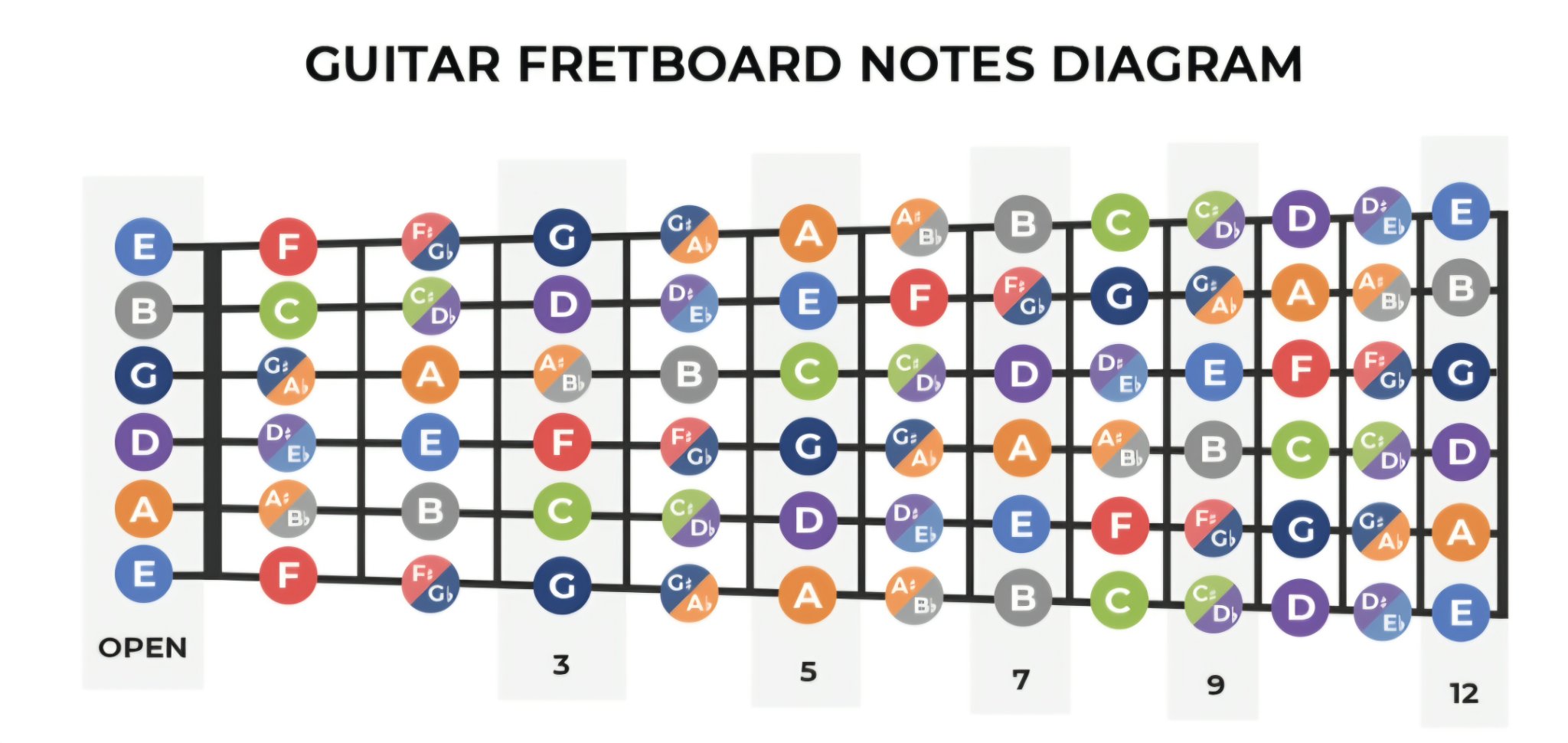
THE GUITAR
YOUR VOICE, RETURNED — § —
Three reflections of the same voice: itself, its tones, and the dial.
the dial’s note, on the stafflow notes ride the ledger lines below, high notes above — exactly as written music does
Exact:Hz — type it, or step it
Volume
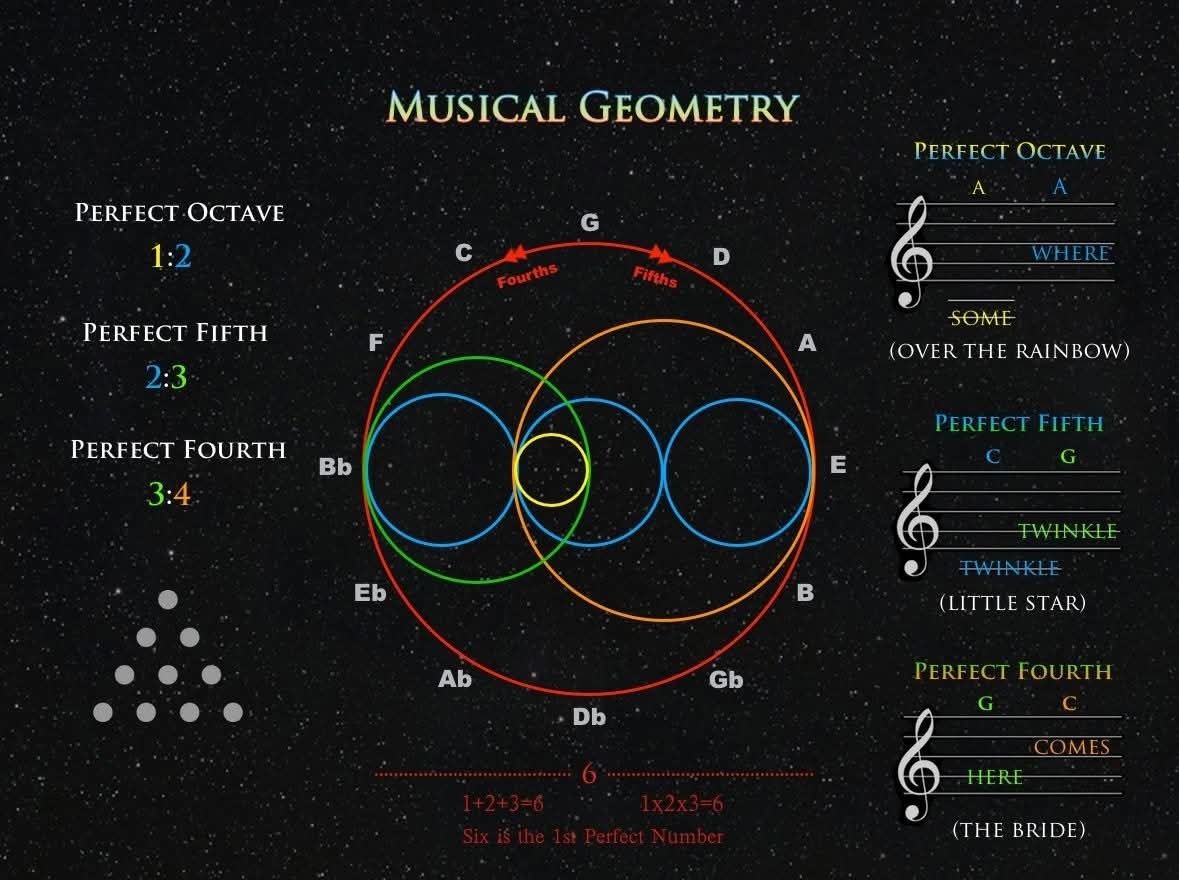
PYTHAGOREAN INTERVALS — THE MONOCHORD
Pythagorean Intervals — classical geometry maps perfectly to musical relationships, such as the exact mathematical ratios found in octaves and perfect fifths.
220 Hz
One string, one movable bridge. Where the bridge stands decides the note — geometry you can hear.
YOUR COLOUR — THE OCTAVE LADDER — § —
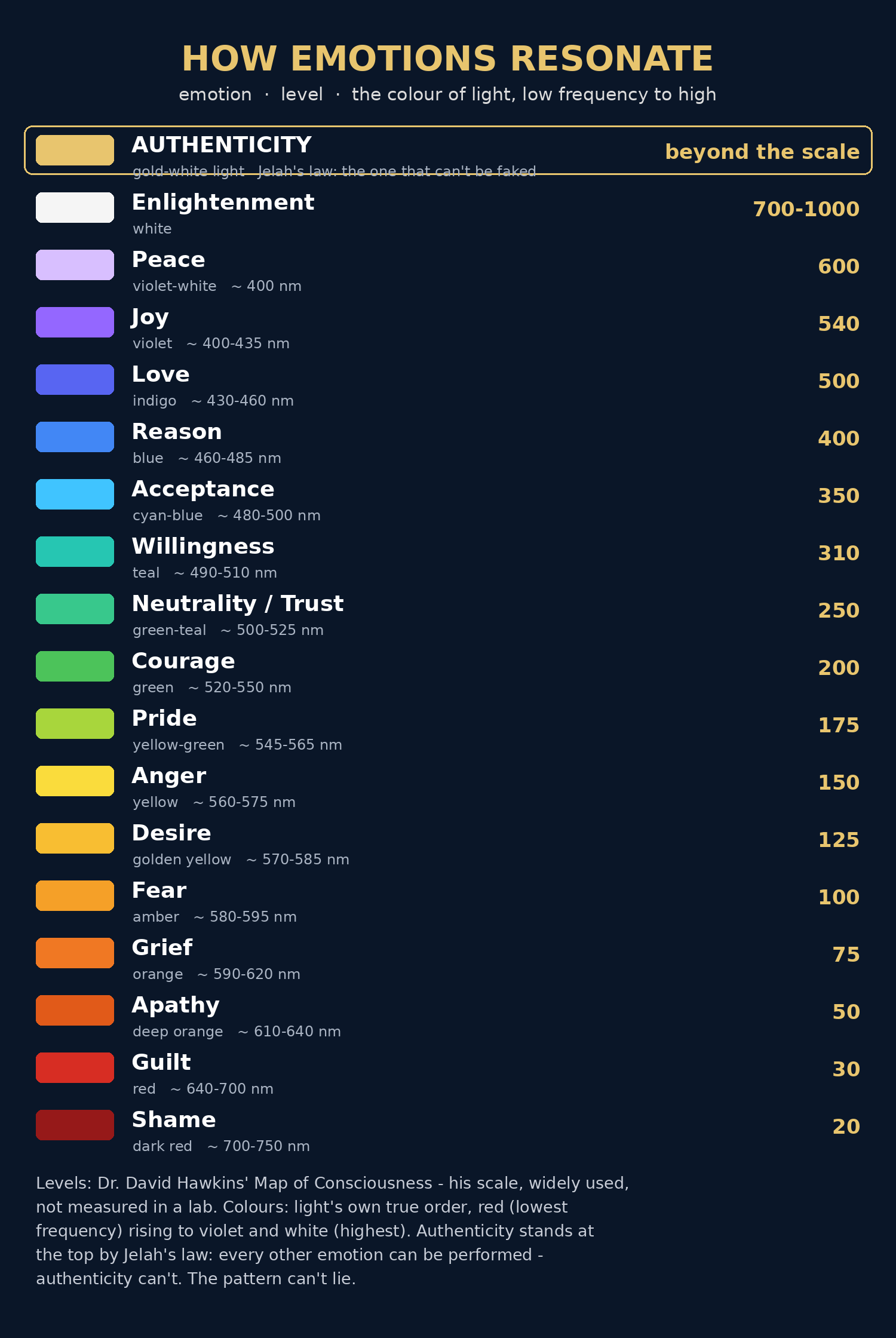
Every note climbs by doubling. Double a sound's frequency about forty times and it leaves the ear and enters the eye — sound's highest octaves are colours. Newton divided his rainbow into seven colours to mirror the seven notes of the scale. Here is your voice on that ladder: your root, its octaves, and the colour your root lands on.
The chart above is the reference map (the Hawkins scale, labelled in the chart as a scale of consciousness — a map, not a lab measurement). Your colour below is computed from your own voice by octave arithmetic: your root frequency, doubled into the visible band. A correspondence, drawn honestly — not a diagnosis.
Solfeggio Frequencies — a system of 9 ancient sacred tones (such as 174 Hz, 285 Hz, 432 Hz, and 528 Hz) believed to stimulate specific emotional or biological states.
Schumann Resonances — integrating global electromagnetic frequencies (like the Earth’s baseline 7.83 Hz) with sub-bass audio tones to create grounding, meditative acoustic tracks.
CHAKRA MAPPING — THE BODY
Chakra Mapping — sound healers often map individual musical scales to the human body, such as matching the throat chakra to vocal activation or specific musical pitches (e.g., note A or G) to encourage self-expression.
tap a chakra — or play the ladder
The map as sound healers draw it — seven stations, seven notes, root to crown.
AURAS
The Bio-Well reads the fingertips. Here your fingertip meets the instrument instead: press, lift, and press again, until the read completes — and your field is drawn in the colour of your own voice. Nothing here reads your fingerprint. Your print is never taken.
Press the circle with your fingertip — lift, and press again.
Press — 0 of 6
Record your voice, and your field will take its colour.
Only if you want it: this reading can stand in your records, under your personal identification.
THE STRESS INDEX — YOUR AUTONOMIC SNAPSHOT
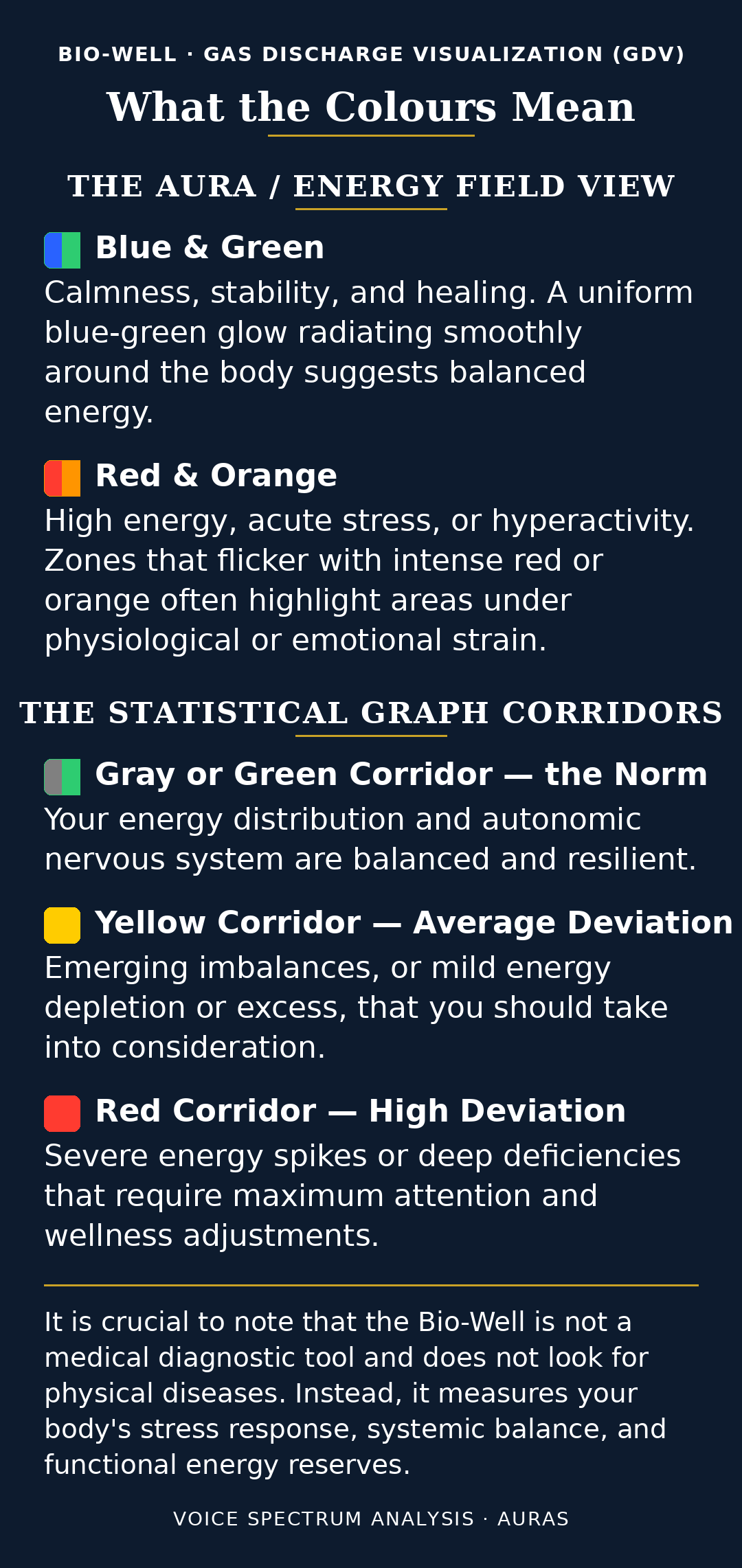
One of the most immediately useful outputs is the Stress Index — a single score derived from the overall entropy and area of your fingertip emissions. A published study confirmed that this GDV-derived stress measure correlates with heart rate variability (HRV) — the gold-standard autonomic nervous system biomarker.
0.0
stress index
0 — Deeply relaxed10 — Extreme stress
Low stress (0–3)
Relaxed autonomic state. Parasympathetic dominance. Energy field appears full and symmetrical. This is the optimal zone.
Drag the slider to see what each number on the Bio-Well Stress Index means. This is an explorer of the scale, after Bio-Well (bio-well.com) — the instrument does not take fingertip emissions, and the Stress Index is not a medical diagnosis: it reflects stress response, systemic balance, and functional energy reserves.
MORSE CODE — § —
Speak it in, or type it in — it comes back in Morse: by tone, by touch, by light.
THE LIGHT
SPEED
One dot = 90 ms
PLAY TOGETHER
READ MORSE FROM A PICTURE
Clean, straight Morse reads best. A tilted or dim photo may read rough — the words it finds stand below, so a wrong letter can be seen.
THE SIGNAL FAMILY — § —
Every letter, in every language of signal — the poster, redrawn in the instrument’s colours, verified cell by cell against NATO’s standard (2018).
SIGN LANGUAGE — § —
Sign language — the hand signs for every letter.
WRITE IT IN SIGN LANGUAGE
SPEED
One sign = 800 ms
PLAY TOGETHER
These signs spell words letter by letter — the fingerspelling of the chart below. Sign language is a full language of its own; this is its alphabet, put to work.
BRAILLE — § —
Translate physical braille into plain text or teach braille literacy using mobile devices
READ BRAILLE — § —
Use side lighting: position a light source from the side to cast shadows on the raised dots so the software can detect them clearly.
WRITE IT IN BRAILLE
PLAY TOGETHER
Reading Braille from a picture happens on this device. Translating into another language uses the same translation road as Language Spectral Analysis.
Clean, straight, side-lit Braille reads best. A tilted or dim photo may read rough — the text it finds stands below, so a wrong letter can be seen.
THE ORIGIN TONGUE — § —
WRITE IT IN ARAMAIC
Type your words — they come back written in Aramaic, and the button plays them in Aramaic. Type Aramaic — it comes back written and spoken in your language.
This converter writes letter for letter from the verified alphabet above — it spells words in Aramaic letters; it does not translate their meaning. The ancient script writes the consonants: A rides on Alaph, I on Yodh, O and U on Waw, and E is not written, as the old letters did not write it. When it plays, it speaks the letters’ sounds spelled out in your language — a true Aramaic voice does not exist on any phone yet. It grows here, reading by reading.
PRACTICE — LEARN IT HERE
The first line, word by word. Tap a word: see it in Aramaic, hear it played, and spell it letter by letter.
EVERY LETTER — TAP IT, HEAR IT
Tap any letter: see it large, and hear its name and its sound.
“In the beginning was the Word, and the Word was with God, and the Word was God.” JOHN 1:1 ALL GLORY BE TO GOD
Voice Spectrum Analysis (VSA) is an exploratory instrument for meeting your own voice as pattern and tone. It is not a medical device, and it does not diagnose, treat, cure, or prevent any medical condition — it listens, it measures, it reflects.